
Apprenticeship, Not Tools
You don't learn carpentry from a textbook.
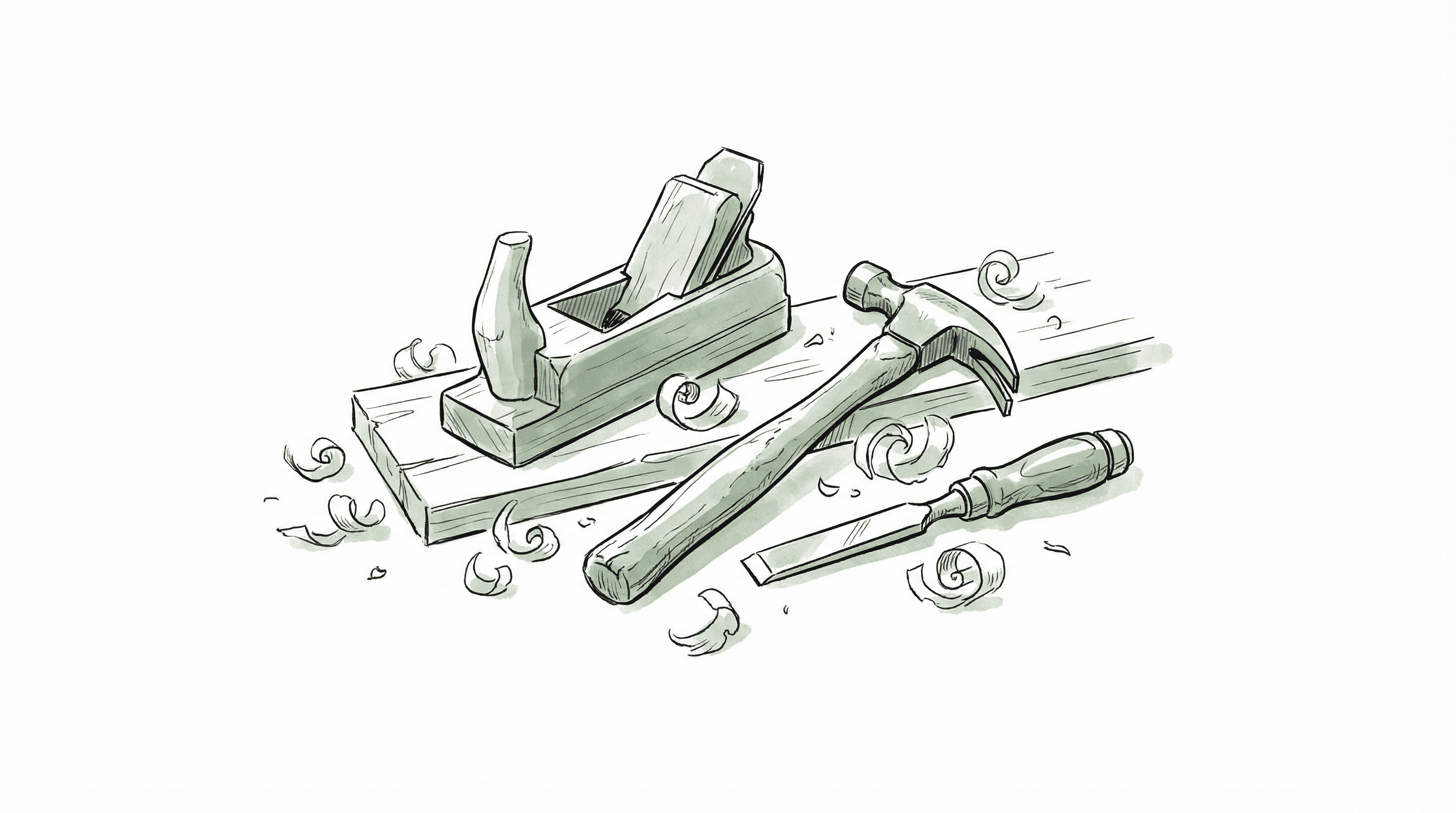
You learn carpentry by building a chair next to someone who's already built a thousand chairs.
They show you the tools. They explain why this wood works better than that wood. They let you mess up a joint and fix it. They watch you sand and refinish. You ask questions in real time. You learn by doing.
That's apprenticeship.
And it's the oldest, most effective learning model humans have ever created.
Why Apprenticeship Works
Schools teach you about things. Textbooks teach you about things. YouTube videos teach you about things.
Apprenticeship teaches you how to do things.
There's a massive difference.
When you learn carpentry from a textbook, you understand wood grain, joinery angles, sandpaper grit sizes. You can pass a test. You can explain the concepts.
But when you actually need to build something? You freeze. Because understanding isn't the same as knowing.
Knowing carpentry means your hands understand. Your eyes understand. Your judgment understands. That only comes from doing it, repeatedly, alongside someone who already knows.
The master carpenter doesn't teach you theory. They say: "Here, hold this chisel like this. Feel the angle. Now try on this piece of scrap. See how that splits? You went too deep. Here's the pressure you need."
You learn through correction, through practice, through real work.
This is why apprentices became masters. Not because they studied hard. But because they built thousands of things alongside someone who knew what they were doing.
We Forgot This Model
Somewhere around the industrial revolution, we decided all learning should look like school.
Sit in a room. Listen to someone talk. Read books. Take a test. Get a certificate. Move on.
This works okay for abstract knowledge. For history, math, chemistry—subjects that exist on paper or in theory.
But for how to actually do something with skill, the classroom model is terrible.
You can't learn sales from a textbook. You can't learn writing from a lecture. You can't learn AI from a video course.
You learn these things by doing them, getting feedback, adjusting, doing them again. Ideally alongside someone who's already good at it.
For a few decades, we pretended YouTube tutorials and online courses solved this. They didn't. They just made it easier to think you learned while actually not learning much at all.
You can watch a thousand YouTube videos about freelancing and still have no idea how to handle a difficult client. You can read every writing guide ever and still struggle to write something people actually want to read. You can take every AI course available and still have no idea how to use AI effectively for your specific work.
Because you weren't doing it. You were watching someone else do it.
AI Changed Everything (And We Didn't Notice)
Here's what's interesting: AI makes apprenticeship possible again.
For the first time in a century, anyone can have a mentor at their fingertips.
Not a video of a mentor. Not a course made by a mentor. An actual mentor who can see your specific situation and help you navigate it in real time.
This brings back the master-apprentice model—but in a modern version.
A master carpenter can only mentor one or two apprentices at a time. They have limited capacity. You have to live nearby. You have to work their schedule.
But an AI coach—or a real creator packaged as an AI coach on Ask Mojo—can be available to thousands of people, adapted to each person's specific situation.
This is revolutionary. We just needed the right tools to make it work.
Why Does Mentorship Work Better Than Courses?
1. Learning Happens Through Doing, Not Studying
You don't learn "about" AI. You learn how to use AI.
Instead of taking a course on "AI for Content Creators," you work on your actual content project alongside a content creator mentor. They see what you're trying to do. They know which AI tools will actually help you. You use those tools. You get feedback. You adjust.
Learning happens automatically because you're solving a real problem.
2. Feedback is Instant and Specific
A textbook can't tell you: "That's the right direction, but you're customizing the prompt wrong for your audience. Try this adjustment instead."
A mentor can. In real time. For your specific situation.
This is how expertise develops. Not from knowing the theory. But from trying something, getting feedback, adjusting, trying again.
The feedback loop is what makes real learning possible.
3. You Learn What Matters, When It Matters
A course teaches you everything. Most of it, you don't need.
A mentor teaches you what's relevant right now.
You're struggling with client communication? That's what your mentor focuses on. You're not taking a module on "Email Basics" when you actually need help with tone and personalization for difficult conversations.
Mentorship is efficient. You learn the 20% that matters 80% of the time, exactly when you need it.
The Apprenticeship Loop
Here's how it actually works:
You have a real problem. Maybe you're a solopreneur and you can't keep up with client communication. Maybe you're a content creator and repurposing feels like it takes forever. Maybe you're in sales and you keep getting ghosted after initial contact.
You ask your mentor. Not "How do I use AI?" but "Help me with this specific thing I'm stuck on."
Your mentor sees your situation. They know your clients, your content strategy, your sales approach. They're not giving generic advice.
They show you a workflow, a playbook, a technique. Customized for your situation, not for "everyone."
You use it. You apply it to your real work. Real results happen. Real learning happens.
You get feedback. What worked? What didn't? How to adjust for next time?
You try again. Better. Smarter. More efficient.
This is the loop. Problem → Mentor → Skill → Application → Feedback → Better Application.
That's how you become good at something. Not from study. From doing it repeatedly alongside someone who knows.
Why This Matters for AI
Most people approach AI like they're taking a course.
They watch YouTube videos about AI. They read Twitter threads about prompts. They take courses on "AI for Your Industry." They collect hundreds of prompts from everywhere.
Then they sit down to use AI and... nothing happens. They still feel lost. The prompts don't fit their work. The techniques don't apply to their situation. The knowledge doesn't stick.
This is why so many people say "AI doesn't actually help me." It's not that AI doesn't work. It's that they're learning about AI instead of learning how to use AI.
A mentor changes this completely.
Instead of studying AI in the abstract, you use AI to solve your actual problems. The mentor guides you. Real learning happens. Real results happen.
Two Paths Forward
The Course Path: Take the AI course. Learn about models and tokens and prompts and parameters. Get a certificate. Feel educated.
In a month, you forget most of it. You still don't know how to use AI effectively for your work.
The Apprenticeship Path: Start working alongside a mentor. They show you workflows customized for your niche. You apply them to real problems. You get feedback. You improve.
In a month, you've built actual workflows. You've solved real problems. You understand how AI helps you specifically. Learning stuck because it happened through doing.
The Coach Types
Both types of Ask Mojo coaches work because both offer the apprenticeship model:
Real creator coaches have already done the thing you're trying to do. They learned by doing (the hard way). Now they're teaching you the faster way by showing what they learned. They understand your niche deeply because they work in it.
AI coaches are specialists Ask Mojo creates for specific domains. They have specific knowledge, effective frameworks, and systems that work for that niche. They adapt to your level and your specific situation.
In both cases, you're learning through apprenticeship, not through study.
What This Means
Learning changed when books were invented. For the first time, knowledge could be transferred without an expert standing next to you.
Books were revolutionary. But they made us forget something important: the most effective learning happens alongside someone who knows.
AI brought apprenticeship back. Not by replacing mentors with machines. But by making it possible for everyone to have a mentor available, adapted to their specific situation, available whenever they need it.
This is how you stop feeling lost with AI. Not by taking another course. But by working alongside someone who understands your niche and can show you exactly what to do.
That's apprenticeship. That's how humans learned for thousands of years. That's how you actually get good at something.
And for the first time in a century, it's possible again.
Ask Mojo brings apprenticeship back — faster, more personalized, and available to everyone.
If that sounds like how you want to learn, we'll see you soon.