
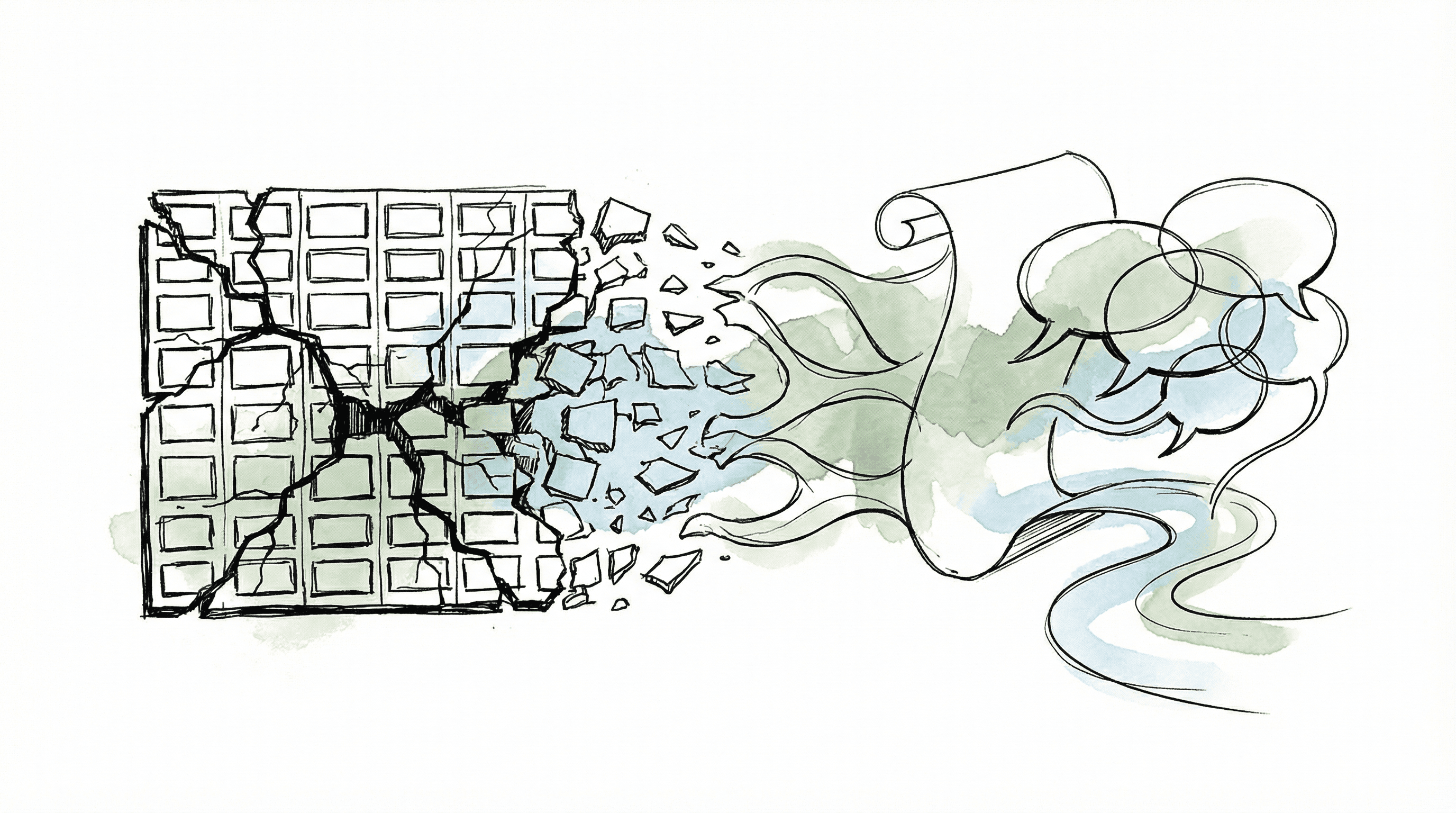
You Don't Need Another App. You Need a Playbook.
Every SaaS tool you use was built on the same assumption: the software knows what you need better than you do.
I used to believe that too.
After years of building web tools for small businesses, I've watched this cycle play out hundreds of times. An entrepreneur has a problem. They find a SaaS (Software As A Service) that promises to solve it. They sign up, watch the onboarding video, click through dashboards someone else designed.
Then they realize: this tool solves someone else's version of their problem.
You're renting someone else's opinion
Your CRM organizes contacts the way they think contacts should be organized. Your SEO tool shows data in their format. Your project management app forces their workflow on your team.
You adapt to the tool. Not the other way around.
I call this data-centric software. The entire product is built around a fixed data model. The developers decided — before you ever showed up — what inputs you'd need, what outputs you'd get, and how the whole thing would flow.
It's worked for 20 years. But I think it's about to stop being the only option.
What happens when AI enters the picture
Here's the shift I've been thinking about for months:
When you can describe what you want in plain language, and an AI agent executes it — why do you need a dashboard? Why do you need someone else's workflow?
The SaaS tools aren't going away. Their databases, their algorithms, their integrations — all of that is still valuable. But increasingly, you'll access them through APIs. Not through their websites.
The website becomes optional. The API becomes essential.
And what sits between you and those APIs?
A playbook.
Playbooks: the new unit of work
A playbook is a structured way to solve a specific problem. It defines what problem you're solving, what steps to follow, what external services to call, what output to produce.
But here's the key difference from a SaaS product: you control the playbook.
You can modify the steps. Change the inputs. Swap one service for another. Tell the agent "actually, format this differently" or "skip step 3, I already have that data" or "add a step that checks competitor pricing."
You do all of this by chatting. No code. No configuration screens. No "upgrade to Pro to unlock this feature."
The playbook adapts to you. Not the other way around.
That's what I mean by user-centric software. The problem is defined. But the solution is yours to shape.
A concrete example
Let's say you need B2B leads for your consulting business.
The data-centric way: You sign up for a lead generation tool. You pick from their predefined filters — industry, company size, location. You get a list formatted the way they decided. If you want to cross-reference with recent funding news, that's a different tool. If you want their social media activity, that's another subscription. Each tool gives you its view of the data.
The user-centric way: You open a chat and say: "I need 20 consulting firms in Paris that recently raised funding, with the decision-maker's name and LinkedIn, and a short summary of what they do." The playbook calls the right services, combines the data the way you asked, and gives you exactly what you need. Next week, you say: "Same thing but for Berlin, and add their tech stack." Done. Instantly.
Same problem. Completely different experience.
Why this is happening now
Three things are converging at the same time:
AI agents can now execute multi-step tasks. Not perfectly. But well enough for most business workflows. A year ago this wasn't true.
Every major SaaS is exposing APIs. The tools are there. The data is accessible. What's missing is an orchestration layer that works for you — not for the average user they had in mind.
People are tired of learning new interfaces. Every new SaaS means a new dashboard, new terminology, new mental model. Chat is universal. Everyone already knows how to use it.
We're moving from a world of applications to a world of capabilities. You don't need "a lead gen tool." You need the capability to generate leads, on your terms.
What I'm building
This is the philosophy behind everything I'm working on right now.
I'm launching a series of specialized sites, each built around a specific problem. B2B lead generation. Real estate market research. Business intelligence automation.
Each site is a playbook you can use immediately, customize by chatting, and make your own. Not a dashboard with fixed features. A flexible process that adapts to how you work.
And behind all of this, AskMojo is the platform where you create your own playbooks, connect your own services — Gmail, Notion, your CRM, whatever you use — and run them through an AI agent or directly in chat.
The traditional SaaS model isn't dead. But it's shrinking to what it always should have been: infrastructure. APIs and databases. The interface layer — the part that actually touches your work — is moving to playbooks and agents.
The question to ask yourself
It's not "which SaaS should I subscribe to next?"
It's: "What playbooks do I need to run my business?"
Because once you have the right playbooks, customized to your exact needs, you won't want to go back to clicking through someone else's dashboard.
I'll be sharing real examples as each site launches. Stay tuned.